NYISO's 2026 Capacity Market Direction: Why Transmission Security May Need a Price Signal
NYISO is examining whether the capacity market should more directly value a resource's contribution to transmission security. This is market design work—not an effective rule—but it points to a more explicit role for location, availability, and reliability contribution.
Key terms
10 terms used in this guide, kept within a 20-term reading limit.
- ICAP
- NYISO's Installed Capacity market.
- Resource adequacy
- Enough supply to meet aggregate demand and expected outages.
- Transmission security
- The grid's ability to remain secure after disturbances or equipment loss.
- LCR
- Locational Minimum Installed Capacity Requirement.
- TSL
- Transmission Security Limit.
- Demand curve
- An administrative curve used to procure and price capacity.
- Accreditation
- The method used to assign qualifying capacity value to a resource.
- Co-optimization
- Joint optimization of two system requirements in one process.
- UCAP
- Unforced Capacity after expected outage adjustments.
- Ancillary services
- Operating products that support grid reliability.
How the current capacity market sees reliability
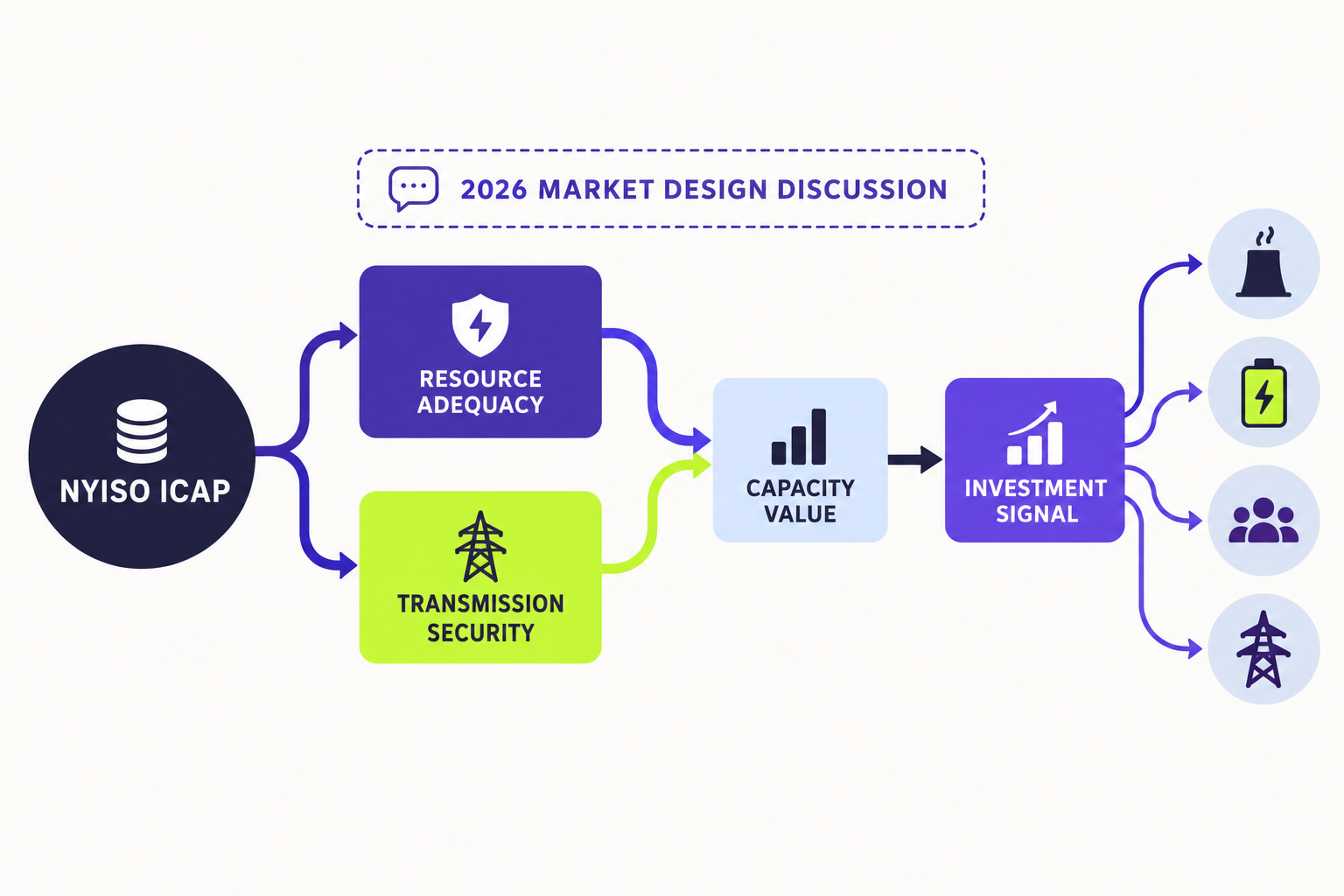
NYISO separates reliability into resource adequacy and transmission security. The ICAP market directly optimizes resource adequacy, while transmission security is reflected indirectly through locational minimum capacity requirements and transmission security floors. When the two methods assign different value to a resource, the market may not fully express its actual system contribution.
- Resource adequacy asks whether aggregate supply is sufficient
- Transmission security asks whether a location and network can withstand contingencies
- Existing locational requirements already provide part of the signal
Research note: The design question is how to express transmission value more directly—not whether the current market ignores transmission entirely.
What NYISO is discussing for 2026
NYISO lists options including a second set of demand curves, revised capacity accreditation, an auction that explicitly prices transmission security and co-optimizes it with resource adequacy, or incorporation of transmission security into the resource adequacy model. The 2026 milestone is market design work; stakeholder, tariff, and regulatory steps would still be required before a rule becomes effective.
- Separate demand curves could express two reliability needs
- Co-optimization could value a resource against both needs
- Accreditation changes could alter how much capacity a resource may sell
Research note: This is an official project direction, not an approved tariff and not base-case revenue.
What this could mean for storage and flexibility
A design that recognizes location and timing more precisely could make the reliability contribution of fast storage, demand response, and dispatchable resources easier to demonstrate in constrained areas. It does not guarantee higher capacity revenue for every battery. Availability, duration, location, interconnection rights, and testing rules would still shape accredited capacity.
- Identify the asset's capacity zone
- Test duration and availability in critical hours
- Include derates, outages, and performance testing
- Avoid double-counting capacity and other market revenues
Research note: A well-located resource that cannot perform in the relevant hours may still fall short of expected capacity value.
What should change in an investment model
Avoid using one statewide capacity price as the entire revenue case. Separate energy, capacity, ancillary service, and congestion value, then build accreditation, price, and performance scenarios by location. While rules remain under development, use ranges rather than treating a discussion document as base-case revenue.
- Maintain a current-rule base case
- Add upside and downside cases for explicit transmission-security pricing
- Version accreditation and demand-curve assumptions
- Connect outputs to cash flow and debt coverage
Research note: Rule risk belongs in scenarios and sensitivities—not only in a report footnote.
How an AI energy platform can help
Software should connect market-rule versions with asset location, available capacity, duration, historical performance, and settlement evidence. When rules change, the platform can recalculate accredited capacity and revenue sensitivity while preserving the source of every assumption.
- Maintain a versioned rule and parameter library
- Check whether asset data satisfy scenario conditions
- Compare forecast, award, performance, and settlement
- Give investment and operations teams one evidence base
Research note: A governed AI workflow exposes assumptions, sources, and approvals; it does not turn a proposed rule into guaranteed revenue.
Research sources
These sources support the market context and operating methods in this guide. Project decisions should use current local rules, contracts, and engineering evidence.