CHPE in the NYISO Market: Why 1,250 MW Does Not Mean New Trading Room Every Hour
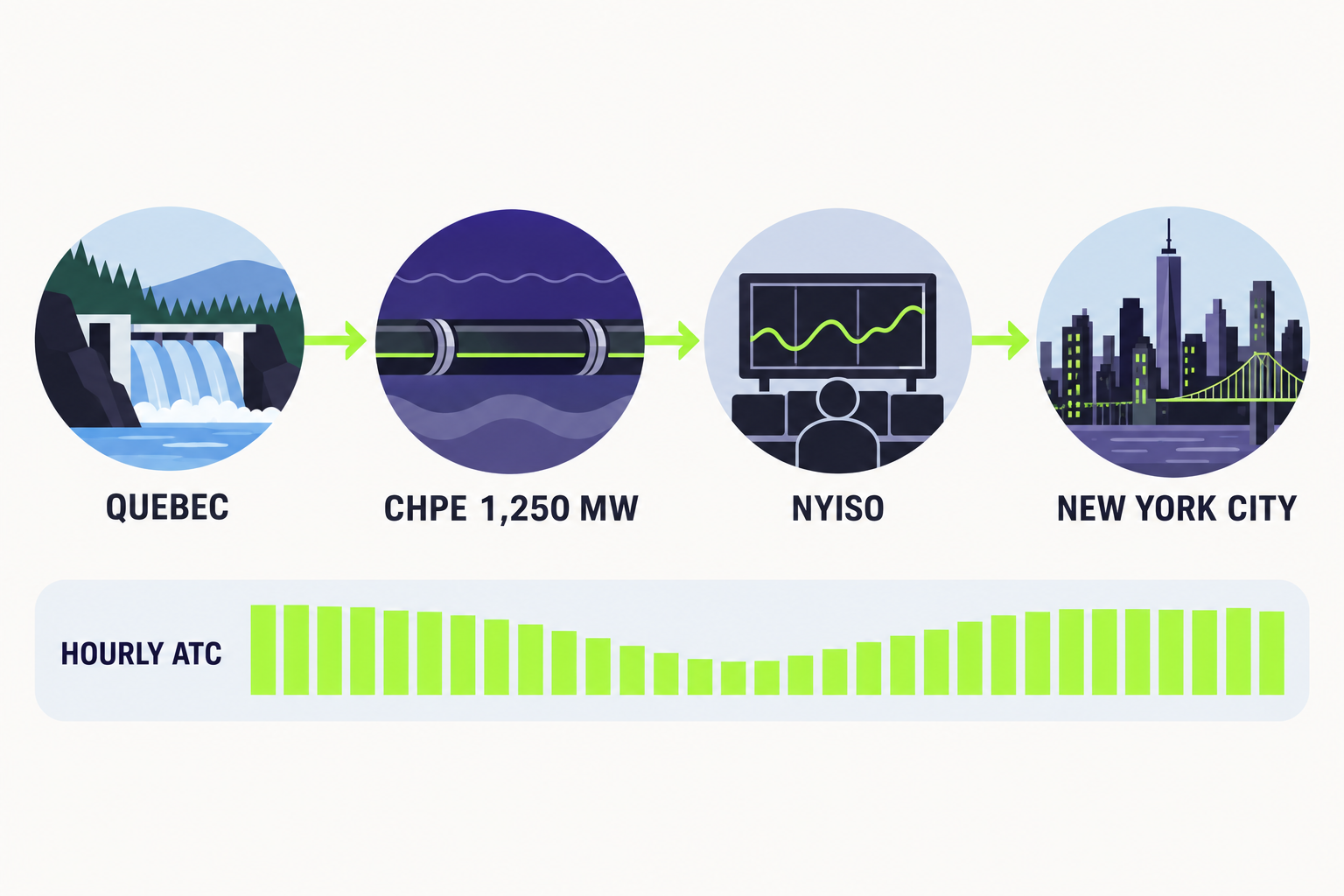
NYISO public data show 1,250 MW of total transfer capability for the CHPE interface, while available transfer capability changes by hour. Investors should separate nameplate capability, remaining commercial room, and actual power flow.
Key terms
10 terms used in this guide, kept within a 20-term reading limit.
- NYISO
- The independent system operator for New York's wholesale grid and electricity markets.
- CHPE
- Champlain Hudson Power Express, an HVDC link between Quebec and New York City.
- TTC
- Total Transfer Capability under stated system conditions.
- ATC
- Transfer capability remaining for additional commercial transactions.
- Actual flow
- Power physically moving across an interface at a point in time.
- LBMP
- Locational Based Marginal Price in the NYISO market.
- Zone J
- NYISO's New York City pricing zone.
- Day-ahead schedule
- A market schedule cleared before the operating day.
- Congestion
- A network limit that separates prices by location.
- Settlement
- Financial reconciliation of schedules, performance, and market rules.
What the latest market data show
NYISO's August 30, 2026 capacity report listed 1,250 MW of expected CHPE imports. Its September 11 ATC and TTC report showed the HQ–CHPE interface at 1,250 MW of TTC for most hours, while ATC fell to 700 MW in hour 16, reached zero in hours 17 through 19, and then recovered. Nameplate transfer capability and remaining trading room are different measures.
- The capacity report provides a system snapshot of expected imports
- The ATC/TTC report shows hourly constraints
- One operating day should not be extrapolated into a long-term revenue case
Research note: Zero ATC does not prove that CHPE stopped delivering power; capability may already be scheduled, reserved, or constrained.
Separate TTC, ATC, and actual flow
TTC is the total amount that can be transferred securely under stated conditions. ATC is what remains after existing commitments and required margins. Actual flow is the electricity physically moving at that time. These measures answer different questions and are not interchangeable.
- Use TTC for total secure capability
- Use ATC for remaining commercial room
- Use schedules and telemetry for actual delivery
- Add LBMP, congestion, and settlement data for revenue analysis
Research note: Treating ATC as an operating-status indicator mixes commercial availability with physical delivery.
What this can mean for prices and assets
CHPE moves Quebec hydropower toward the New York City load center and can support supply and reliability. The price effect still depends on timing, system constraints, and the marginal resource in each zone. Solar, storage, and demand response create value by responding when congestion and scarcity matter—not simply by having installed megawatts.
- Compare hourly Zone J spreads with adjacent zones
- Test high, constrained, and low CHPE delivery cases
- Confirm storage availability, duration, and settlement eligibility
Research note: Added transfer capability can compress some spreads while constrained hours can still create dispatch opportunities.
How AI energy software should read the data
A dependable platform aligns interface TTC, ATC, day-ahead schedules, actual flows, zonal LBMPs, asset availability, and settlement on the same timeline. This helps analysts separate load, fuel, transmission, and asset drivers rather than attributing every price move to one transmission project.
- Preserve timestamps and source versions
- Reconcile forecast, schedule, actual, and settlement records
- Flag missing data and outliers
- Keep every causal claim linked to evidence
Research note: AI is useful for comparison and hypothesis generation, but market rules and operating evidence remain authoritative.
Four checks investors can run today
Confirm whether the revenue model uses TTC, ATC, scheduled imports, or actual flows, then analyze Zone J spreads by hour. Stress-test storage revenue and preserve scheduling and settlement evidence so a single market day is not mistaken for a long-term guarantee.
- Verify the formal definition of every model field
- Check time zones and hourly conventions
- Build high, low, and constrained CHPE cases
- Connect results to asset availability and cash flow
Research note: The best market model is not the one with the most data; it is the one whose assumptions can be traced to sources.
Research sources
These sources support the market context and operating methods in this guide. Project decisions should use current local rules, contracts, and engineering evidence.