Malaysia CRESS 50% Plus Four-Hour Rule: How to Size Solar and BESS Without Overinvesting
CRESS does not require a battery to discharge a fixed 200 MWh every day. The investment question is how to balance 50% firm output, four-hour dispatchability, system access charges, and hourly solar production.
Key terms
18 terms used in this guide, kept within a 20-term reading limit.
- CRESS
- A scheme for corporate renewable procurement through Peninsular Malaysia's grid.
- GEP
- The Green Energy Plant participating in CRESS.
- RED
- The renewable energy developer that owns and operates the GEP.
- Green Consumer
- A corporate buyer procuring green electricity under CRESS.
- BESS
- Battery energy storage system.
- Firm Output
- Dispatchable energy output available to the system.
- Non-firm
- Supply without the same dispatchable capability.
- SAC
- System Access Charge for delivering green electricity through the grid.
- Open Access
- Non-discriminatory access to eligible transmission and distribution networks.
- GSO
- The system operator responsible for security and dispatch.
- Single Buyer
- The mechanism administering registration, scheduling, and settlement.
- NEDA
- Malaysia's New Enhanced Dispatch Arrangement.
- PPA
- The power purchase agreement between developer and corporate buyer.
- Usable capacity
- Power or energy available after operating limits.
- Commissioning
- Testing and verification before commercial operation.
- Solar irradiance
- Sunlight intensity affecting solar output.
- Curtailment
- A reduction in available generation due to system or contract limits.
- Augmentation
- Adding battery capacity over time to offset degradation.
Start with the rule: 50% is power and four hours is duration
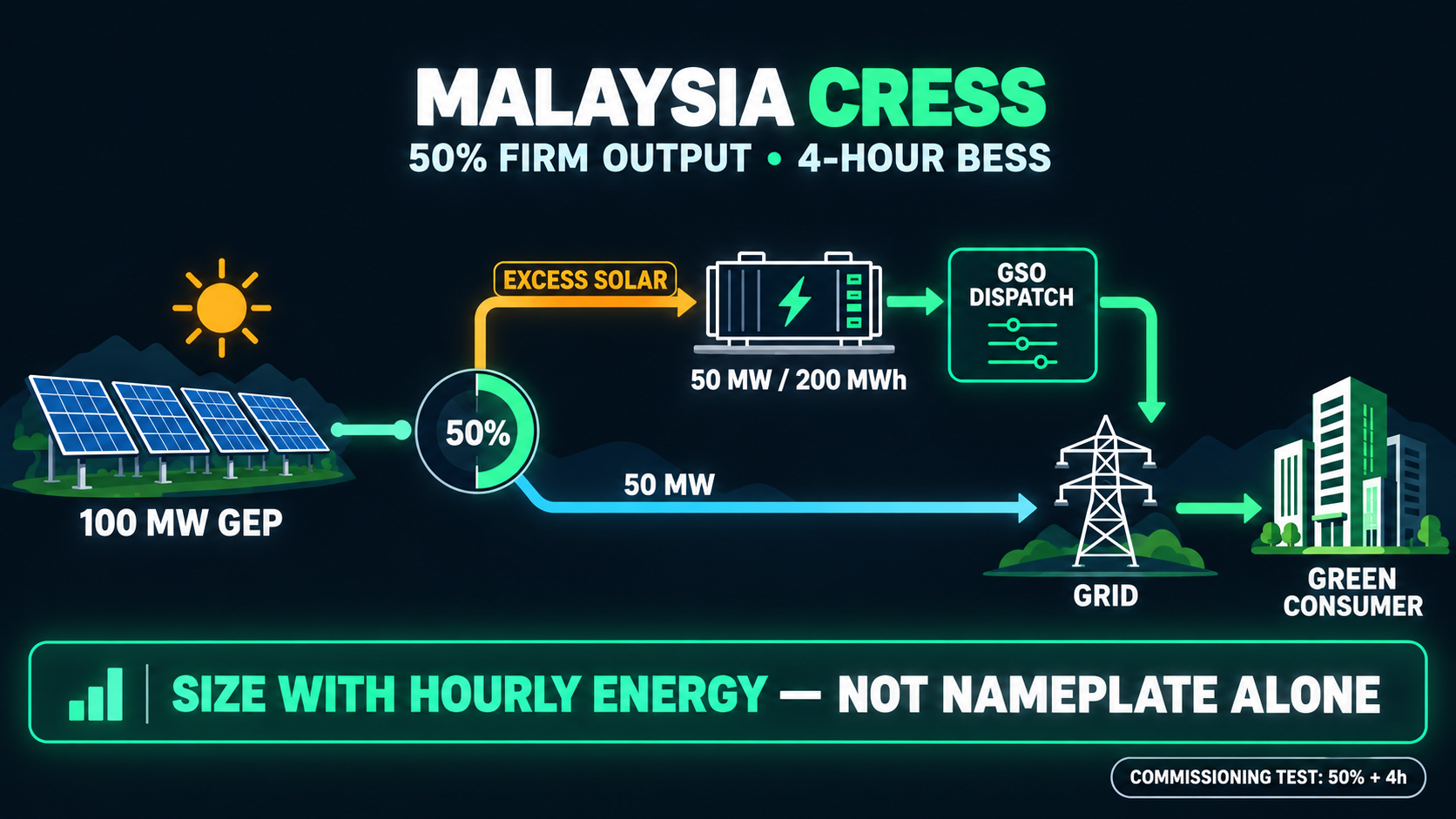
Under the current CRESS Guidelines, a RED whose GEP cannot meet the Firm Output requirement may install directly connected storage. BESS power must be no less than 50% of the lower of registered GEP capacity or tested pre-commercial capacity, for four consecutive hours, and dispatchable by the GSO. The alternative is a higher Non-firm SAC.
- 50 MW is discharge power, not daily energy production
- 200 MWh is the four-hour usable-energy example
- A storage outage can move the project to the Non-firm SAC
Research note: The rule establishes a compliance floor. A larger battery does not automatically create more value.
Insight 1: 200 MWh is not a daily discharge obligation
The Energy Commission's FAQ says the BESS primarily firms GEP output to 50% of capacity. Only solar production above that level is stored and later discharged. Because the surplus depends on weather, irradiance, and module efficiency, 50 MW and 200 MWh are not guaranteed daily throughput. The 50% and four-hour capability is tested during commissioning.
- Cloudy days may not provide enough surplus to fill the battery
- Sunny midday production is the primary charging source
- Actual daily operation follows hourly production and GSO instructions
Research note: Assuming one full cycle every day can overstate energy, revenue, and battery wear at the same time.
Insight 2: size from surplus above the threshold
For a 100 MW GEP, 50 MW is the threshold for identifying surplus solar that can charge the BESS. Utilisation depends on the area of each day's output curve above 50 MW, not nameplate capacity alone. Developers should simulate at least one year of hourly or finer data across weather, DC-to-AC ratio, curtailment, and battery efficiency.
- Calculate chargeable energy above the 50% threshold each hour
- Apply charging power, usable SOC, and round-trip efficiency
- Include degradation, availability, and future augmentation
- Report compliance capacity separately from economic capacity
Research note: Two 100 MW solar plants may face the same compliance power requirement but very different annual throughput and returns.
Insight 3: value starts with the Firm versus Non-firm gap
The Energy Commission announced fourth regulatory-period CRESS SAC rates of 20 sen/kWh for Firm supply and 40 sen/kWh for Non-firm supply. Storage is therefore not only an arbitrage asset. The model should compare potential SAC savings and dispatchable status with the battery's full life-cycle cost. Each project must confirm the applicable tariff, billable energy, and contractual allocation.
- Estimate the SAC gap using actual exported energy
- Do not fully count the same capacity for arbitrage, backup, and firming
- Stress-test low irradiance, outages, and capacity fade
Research note: Oversizing destroys value when SAC savings do not cover added capacity. Undersizing risks losing the value of Firm supply.
A practical six-step sizing workflow
KUNIES recommends placing compliance and economic optimisation in one traceable model. AI can accelerate scenario calculations and anomaly detection, but every result should retain its weather, generation, asset, and tariff assumptions so engineering, finance, and contract teams can review the same evidence.
- Confirm registered capacity, tested capacity, and the applicable threshold
- Build hourly solar production and corporate demand scenarios
- Measure energy available above the 50% threshold
- Apply power, SOC, efficiency, degradation, and GSO constraints
- Compare Firm SAC savings and other benefits with life-cycle cost
- Stress-test low irradiance, outages, and tariff changes
Research note: The best battery is not the largest one. It is the capacity that passes testing, remains dispatchable, and still earns a reasonable return under conservative cases.
Research sources
These sources support the market context and operating methods in this guide. Project decisions should use current local rules, contracts, and engineering evidence.