Thailand's Data Center Power Demand Could Reach 6.8–8.8 GW
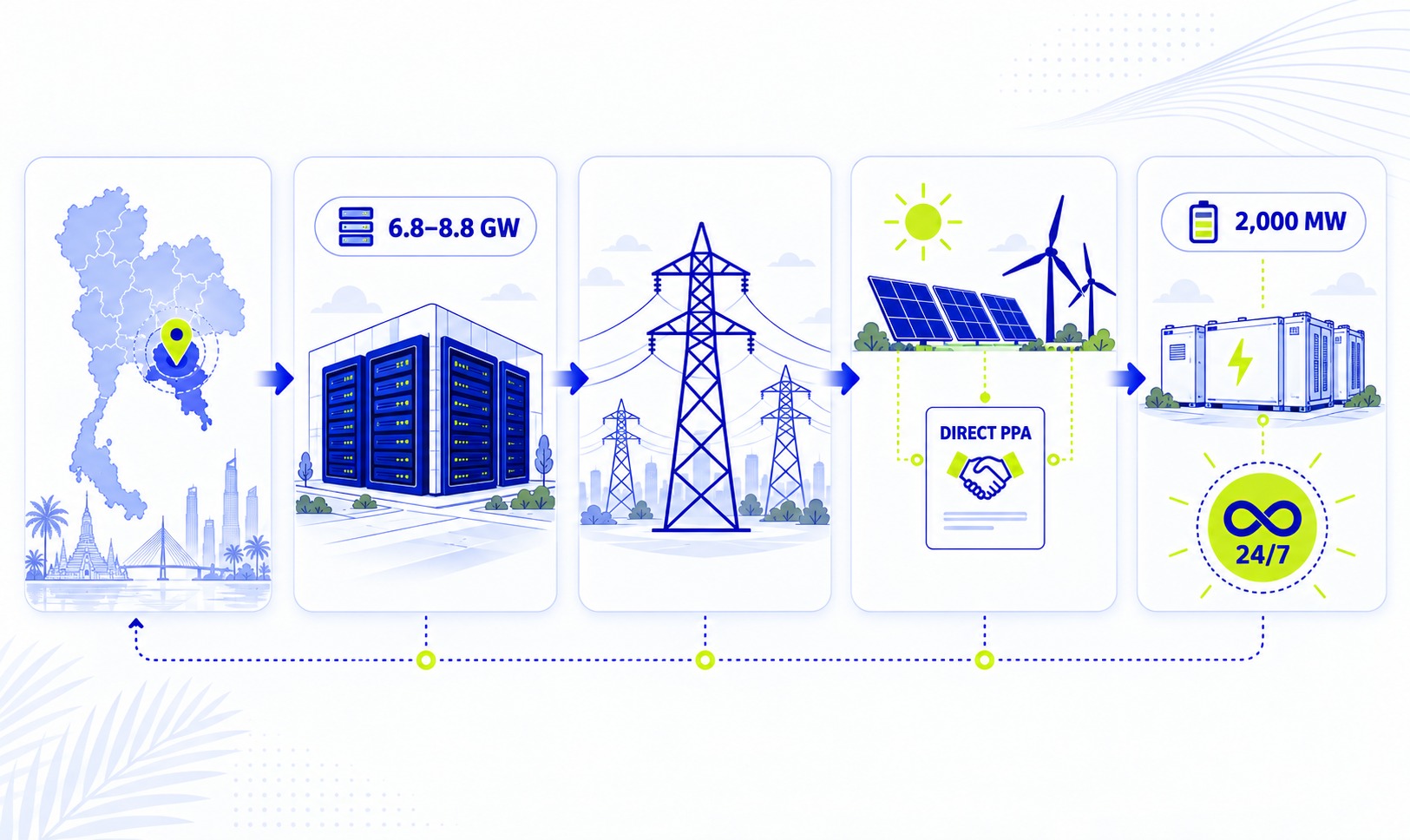
Thailand is bringing large data center demand into national power planning, but the 2,000 MW Direct PPA pilot covers only part of the potential requirement. Bankable delivery depends on grid capacity, renewable contracts, storage, and backup working as one portfolio.
Key terms
12 terms used in this guide, kept within a 20-term reading limit.
- PDP 2026
- Thailand's developing national power development plan.
- Direct PPA
- A power contract signed directly between a buyer and a generator.
- TPA
- Third-party access to use an existing electricity network.
- BOI
- Thailand's Board of Investment.
- IT base load
- Persistent electricity demand from computing equipment.
- Grid capacity
- Power that a local network can deliver safely.
- Green power
- Electricity from qualifying renewable sources.
- Load profile
- A time series showing how electricity demand changes.
- Battery storage
- A system that stores and later releases electricity.
- Backup power
- Supply used when primary power is insufficient or interrupted.
- Hourly matching
- Comparing clean supply and demand hour by hour.
- IPP
- An independent power producer.
The important signal is not investment growth alone
Thailand's BOI reported a 37% year-on-year increase in investment applications in the first half of 2026, with digital infrastructure among the main drivers. More importantly for energy investors, Thai authorities said the draft PDP 2026 includes roughly 6,800–8,800 MW of data center demand. That is a planning range, not a statement that all capacity is approved or immediately deliverable.
- Investment applications can grow faster than grid readiness
- 6.8–8.8 GW is a planning range, not delivered capacity
- Site selection, interconnection, and renewable procurement are becoming one decision
Research note: The market is shifting from counting announced projects to identifying which projects can secure usable power on schedule.
Insight 1: the 2,000 MW pilot covers only part of the potential demand
Thailand's Direct PPA pilot is capped at 2,000 MW. Compared with the 6.8–8.8 GW planning range, that is approximately 23%–29%. This is not a project-level renewable deficit calculation, but it shows that Direct PPA access will be scarce in the first phase and cannot carry the entire market by itself.
- Confirm Direct PPA rights and grid capacity together
- Utility supply, other renewable tools, and backup must cover the balance
- Late energy planning exposes the delivery schedule to regulatory and engineering risk
Research note: The strategic value of a Direct PPA lies in combining source, network access, and delivery timing—not only in its energy price.
Insight 2: the draft favors large projects with credible preparation
The ERC draft links eligibility to BOI support, confirmed grid supply capability, a project term of at least ten years, and detailed forecasts for Direct PPA and utility demand. It also sets a continuous IT base-load threshold of at least 50 MW per building. The pilot is therefore closer to an infrastructure allocation process than a simple corporate green tariff.
- Prepare a ten-year demand and phased commissioning forecast
- Separate Direct PPA demand from utility demand
- Verify both generator and grid eligibility
- Maintain utility backup and supply for deviations from schedules
Research note: Developers with a defensible load profile and delivery plan are better positioned to turn policy eligibility into usable power.
Insight 3: solar addresses daytime energy; storage addresses timing
Data center demand persists around the clock, while solar is concentrated in daylight hours and wind varies with weather. Annual renewable procurement can therefore hide continued nighttime dependence on the grid. Storage can shift some low-carbon energy, reduce short peaks, and provide limited backup, but each duty requires its own capacity calculation.
- Compare load and renewable output with hourly data
- Size peak reduction, time shifting, and backup separately
- Do not count the same battery capacity several times
- Stress-test weather, outages, and usable battery capacity
Research note: The useful metric is not only annual green energy purchased, but verified low-carbon power available in each critical hour.
Investors need an energy delivery map before selecting land
The strongest Thai data center site may not be the site with the lowest land cost. It is the site where grid access, renewable supply, storage, and backup can be delivered on a credible schedule. Before land is finalized, the project should map each capacity, counterparty, date, and fallback.
- Site: substation, network constraints, and expansion timing
- Contracts: Direct PPA, utility supply, and backup terms
- Resources: hourly solar, wind, and storage capability
- Operations: actual load, availability, and exception handling
- Finance: delay, tariff, and renewable-target exposure
Research note: Direct PPAs do not close the gap alone. An integrated supply portfolio turns a policy allocation into operable data center capacity.
Research sources
These sources support the market context and operating methods in this guide. Project decisions should use current local rules, contracts, and engineering evidence.